

issue #205: Oct. 15, 2026
This is your regular free weekly newsletter. If you’re one of our many post-Kona new subscribers, the weekly newsletter on all things triathlon-ish typically goes out Wednesday mornings (California time) — but I picked up the requisite post-Kona cold/flu have been moving slow the last two days.
That’s also why I didn’t do a great job promoting the Massive Big Post-Kona Show we recorded the day after the race — because I got sick right after it went up. Clips from the finish line, interviews with the Salomon staff on the Ironman deal, from-the-ground behind-the-scenes on everything around the race and the week.
Next week’s newsletter: No more talking about Kona.
- Kelly
It’s giving Make Triathlon Great Again
There are two things I miss about racing in the pro field (even at a deeply mediocre level).
One is being really really fit. I don’t miss the constant low-level fatigue, the nursing injuries, or crying in your car, but I do miss feeling like you could run through a fucking wall if you had to. Being generically healthy and fit-in-the-scheme-of-humans just doesn’t have quite the same feel to it now.
The second thing I miss is the before and after with the other pro women. The hanging out and sharing war stories, the knowing there was someone else who been through it. There are a limited number of people in the world who understand that specific experience, and so there was a reason we so often ended up solving life problems while on a bus back to the race hotel, packing bikes in a garage, laying on the ground in the med tent — even if we’d just met in some country we’d never been to before, we knew each other.
It was like a secret handshake into a special club that could only be earned through sweat and tears.
When people talk about “Kona” as shorthand for the race, the week, the idea, what they’re often talking about is that club. A chance to be a part of that club for even just one day. They’re talking about the ephemeral belief that anyone who has ever started “Kona” gets to be in this club, that entry for anyone can be earned.
The exclusivity, the extreme-ness, is part of the appeal. I get it. Just like frats in the SEC or the supper clubs and secret societies of the Ivy League. But there’s a reason those things have inherent problems, too.
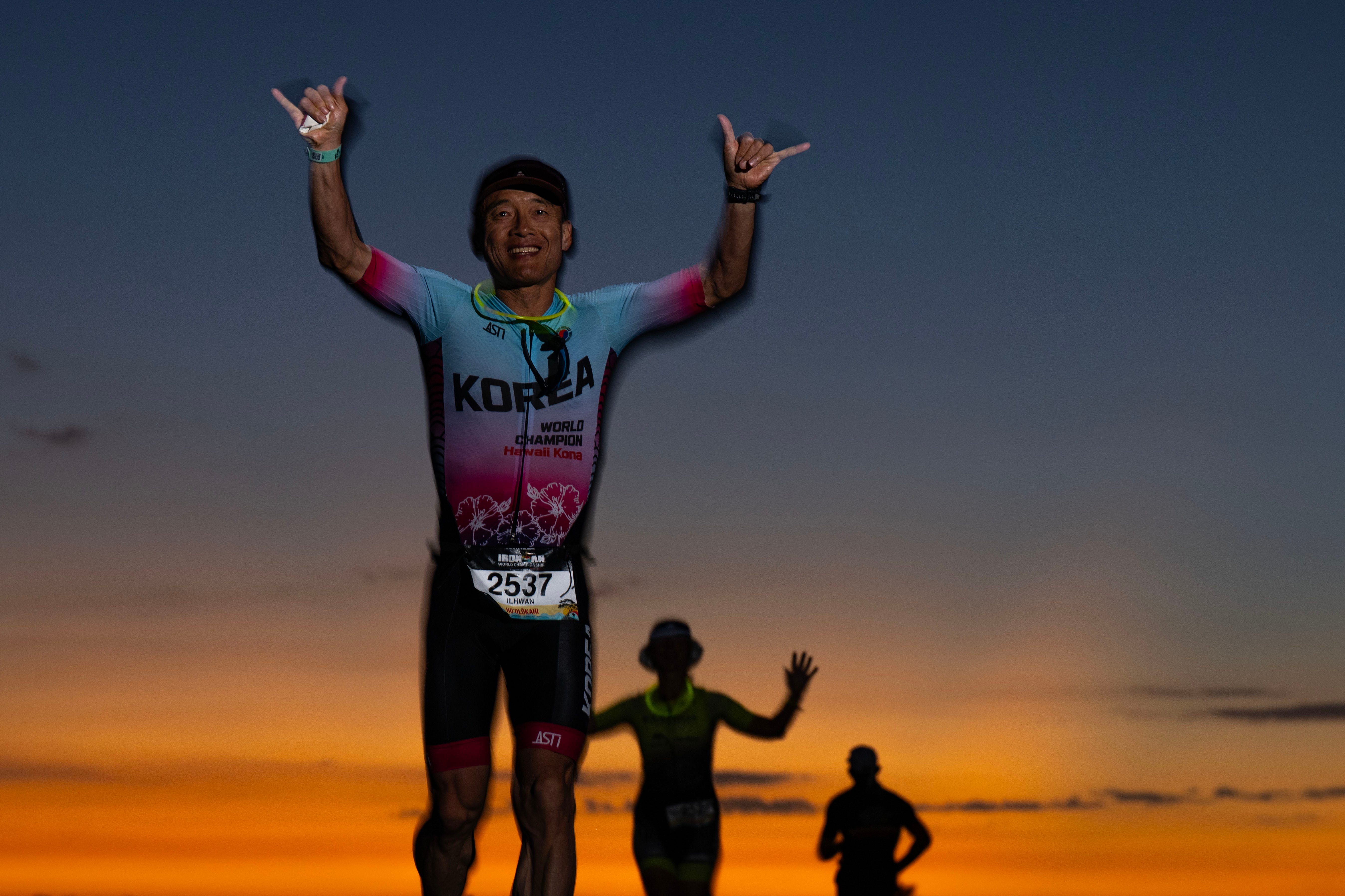
The official theme of Kona this year was: Let’s never again mention Nice.
No, I’m kidding. The official theme was unity and togetherness. Next year’s official theme is now that we’ve come back together, “moving forward with an open heart.” But, really, the theme is “we will pretend the split race rotation of the last three years never happened.” Or whatever that phrase is in Hawaiian.
That theme was an undercurrent — both officially and unofficially — throughout the whole week. Both in what Ironman said and in what so many other people now felt free to say out loud.
Thank God we didn’t let those women ruin Kona, right.
The problem with this overwhelming undercurrent is that we didn’t end up with the split gender race rotation in Nice + Kona just because former Ironman CEO Andrew Messick one day woke up and decided to do it. We ended up with the women’s race and the men’s race in Nice/Kona because Messick was trying to address issues that are still very much issues:
Kona is still deeply size limited, especially if Ironman hopes to grow globally.
Kona is still inherently very expensive, geographically isolated, and difficult to access for much of the triathlon world.
Ironman’s entire business model (now) still rests fundamentally on a volatile local relationship with a small island town.
And it is still true — no matter how many women’s initiatives we launch — that you can not have equally fair and equally premiere men’s and women’s races (pro AND age-group) at the same time within the same race. Coverage and course space is intrinsically limited. We all said the debate was settled on the women having their own race, we all said it couldn’t go back. We all answered Ironman’s survey with the #1 pick actually being that we wanted two days (men’s + women’s) in Kona. And then we just went back anyway.
Messick chose to answer these questions one way. CEO Scott is choosing another way. But those questions still exist. Those facts are still facts no matter how many drinks you have at Huggo’s.
Traditions have a lot of value. Exclusive secret clubs have a lot of appeal. But the problem is they also calcify and harden over time, and you won’t even know the pipes have rusted out until your clubhouse collapses.
A few last things from Kona
The shoes of the top ten pros.
The swim gear.
And the bikes. With the new Pinarello making an appearance.
Also feel like a lot of you will appreciate the pro gear that’s actually available to buy.
And I really appreciated this look at the trends in the bike count (and why those shifts have happened) over 20 years.
Like we mentioned on the podcast, DNF rates appeared high. It’s now (semi-)official: 2,258 athletes finished out of 2,544 (though it’s always hard to tell exactly how many started v. checked in). Which is an 88.7% finish rate. While we had a similar rate in Nice because people more often missed the bike cut-off on that course, it’s a high DNF rate for Kona since age-groupers generally will do anything to get to the finish line. Higher DNF rate among the pros than AGers, of course. Even higher among the pro women this year. Mostly, I think, because of the conditions
Pretty good breakdown of what actually happens to your body.
One AG friend told me he tried to talk to the medical team to tell them he was fine and discovered he sounded like he was having a stroke and his muscles had seized up. Another told me his wife’s legs wouldn’t stop running — she was laying in the med tent with her legs still making a running motion, which apparently happens to about one person/year.
Slowtwitch has all of the age-group winners and a breakdown by country.
The one that stood out to me at the awards ceremony was the woman who the oldest age-group that had female finishers this year (70-74yo), the 71-year-old Laura Rossetti, went 14:03!
The oldest finisher was 80-year-old Simon Butterworth from Ireland.
Former world champ Normann Stadler DNF’d in the age-group field on the bike. Brigitte McMahon, who won gold at the 2000 Olympics and then served a doping ban, took second in the 55-59 age-group.
Some interesting stats on pros who previously raced in Kona as age-groupers.
And, in case you were wondering, the Ironman World Championship page has already been changed over to the "Salomon” Ironman World Championship.
We had one finish line proposal.
Plus, the Ironman Foundation auction is open through the weekend. You could big on Dr. Matt’s Lego bike.
Mark your calendar
A whole bunch of races again on the calendar this upcoming weekend:
Women at Cascais 70.3 (Lizzie Rayner going for the three-peat) and at Florianopolis 70.3 (a nearly all Brazilian field) + men at Malaga 70.3, both men and women at Port Macquarie 70.3 (a nearly all Australian field)
A Challenge race in Spain
And Gwen Jorgensen in the #1 bib at the World Cup in Beijing
The -ish
And just a couple of non-Kona-related things from the past week or two.
Sullivan Middaugh won his first XTERRA World Champ title in New Mexico over the weekend; his dad was also 6th, which is probably more impressive. The race is in New Mexico for at least two more years, so worth checking out. (Slowtwitch)
Ashleigh Gentle and Josh Amberger had their baby. (Instagram)
Ali Brownlee received an OBE from Prince William, which is evidently a step down from knighthood. (World Triathlon)
TTL is accepting new pros and top age-groupers to their racing team this year. (Instagram)
Ironman added a new 70.3 in India. (Ironman)
Extreme flooding meant about 70 runners had to rescued in the middle of Moab 240. (Instagram/The Guardian)
Kipruto and Feysa won the Chicago Marathon, but obviously we all mostly care about the American who got 10th after doing almost all of his training (and he does a LOT of training) on a Planet Fitness treadmill. (Wall Street Journal)
Running v cycling: Which makes you fitter? I’d argue this doesn’t take into account the primary issues, which are logistical: You can go harder for more hours biking, impact isn’t a limiter; but in terms of efficiency you can get more bang for your buck in the same amount of time running, but you have to do less of it. So. (Runner’s World)
Mostly I don’t mountain bike anymore because I kept crashing, but bears chasing you is also a good reason. (Instagram)
No, but actually explain the joke to me about women wearing short shorts in the gym. I don’t get it. (Instagram)
One last thing
Best recap of last weekend’s races.

The issues you mentioned are well stated. I am one of the few that hopes IM starts moving IMWC every year a la 70.3 Worlds. More importantly, the women should get their own day to race. The broadcast was better this year but still sub par compared to other low to mid level sports.